

Why Dingoes Have Lost Their Fear on K’gari (Fraser Island)
I’ve been filming dingoes across Australia for more than four years now. In that time, I’ve been incredibly fortunate to witness a wide range of behaviours — hunting, social bonding, parenting, play, and the quiet moments that most people never see. Dingoes are complex, intelligent animals, and the more time you spend with them, the more you realise how deeply misunderstood they are.
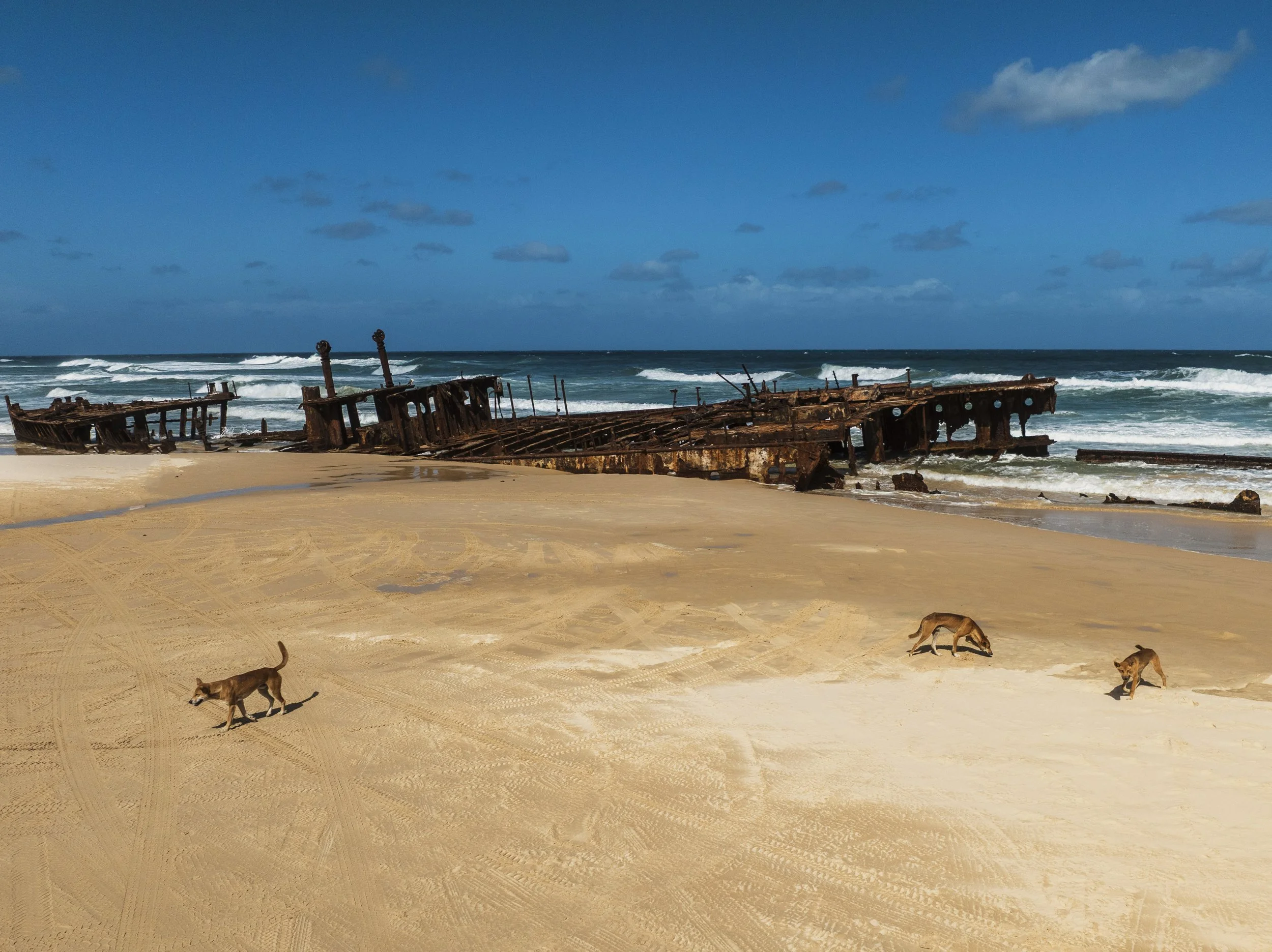
On a recent trip to K’gari, my partner and I were driving along the island’s east coast when a large pack of dingoes emerged from the dunes ahead of us. It was an alpha pair with their offspring — around eight to ten individuals moving together as a cohesive family unit. From a safe distance, I sent the drone up to document them as they headed south along the beach.
What happened next was something I’d never seen before.
K’gari Dingoes photographed by Harry Vincent
A Pack Without Fear
As the dingoes continued along the shoreline, they were intercepted by a group of people who had stopped their vehicles, gotten out, and begun calling the animals over — clearly hoping for close-up photos. Phones were held out at arm’s length. People crouched down to the dingoes’ eye level. Some even leaned toward them.
In all my years of filming dingoes, I had never seen anything like this.
Outside of K’gari, dingoes are typically cautious and highly wary of humans. They keep their distance. They watch. They retreat. Seeing a pack tolerate and approach people so closely was a clear sign that these animals had lost their natural fear of humans. Eventually, when the dingoes realised they weren’t going to be fed, they continued south along the beach. Not long after, they came across a campsite that had been left completely unattended.
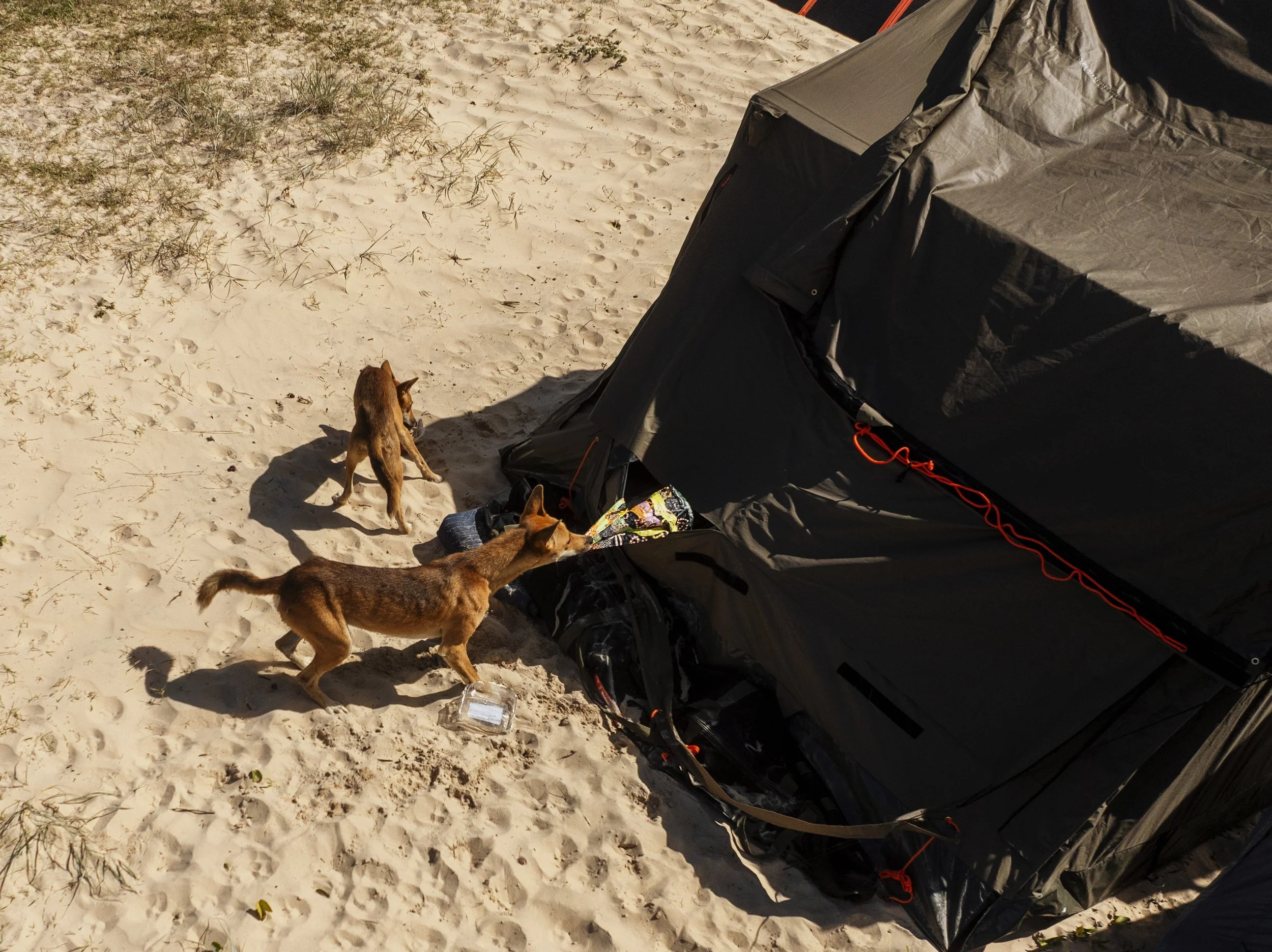
The pack immediately began investigating the campsite, sniffing every surface they could reach. Their movements were confident and deliberate. This was not their first time doing this.
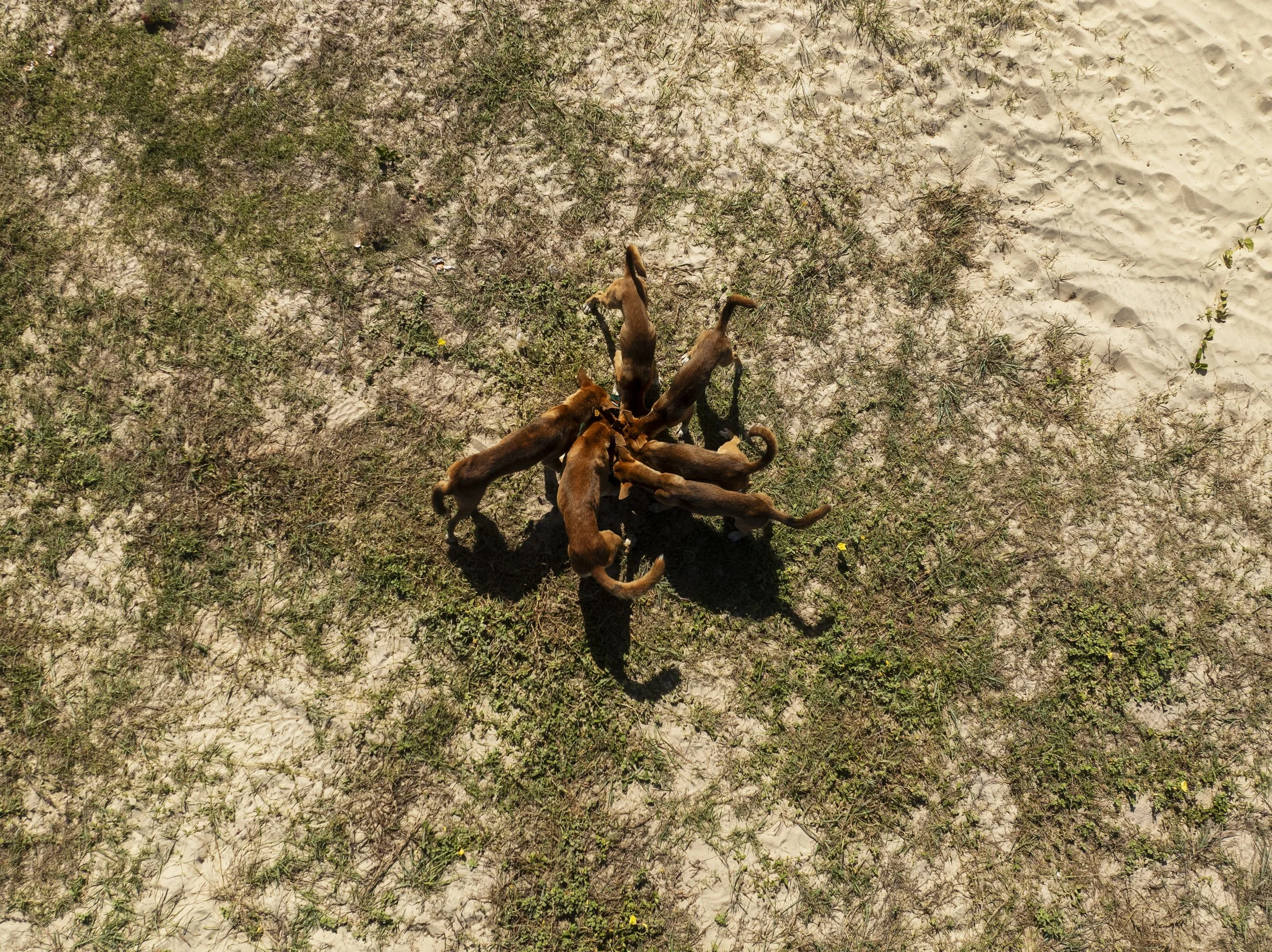
Almost straight away, they discovered food that had been left unsecured inside one of the swags. Opportunistic by nature, the dingoes took full advantage. One of the adults used their nose to pry open the swag, eventually pulling out a large shopping bag filled with food. As the younger pups watched on, they were learning.
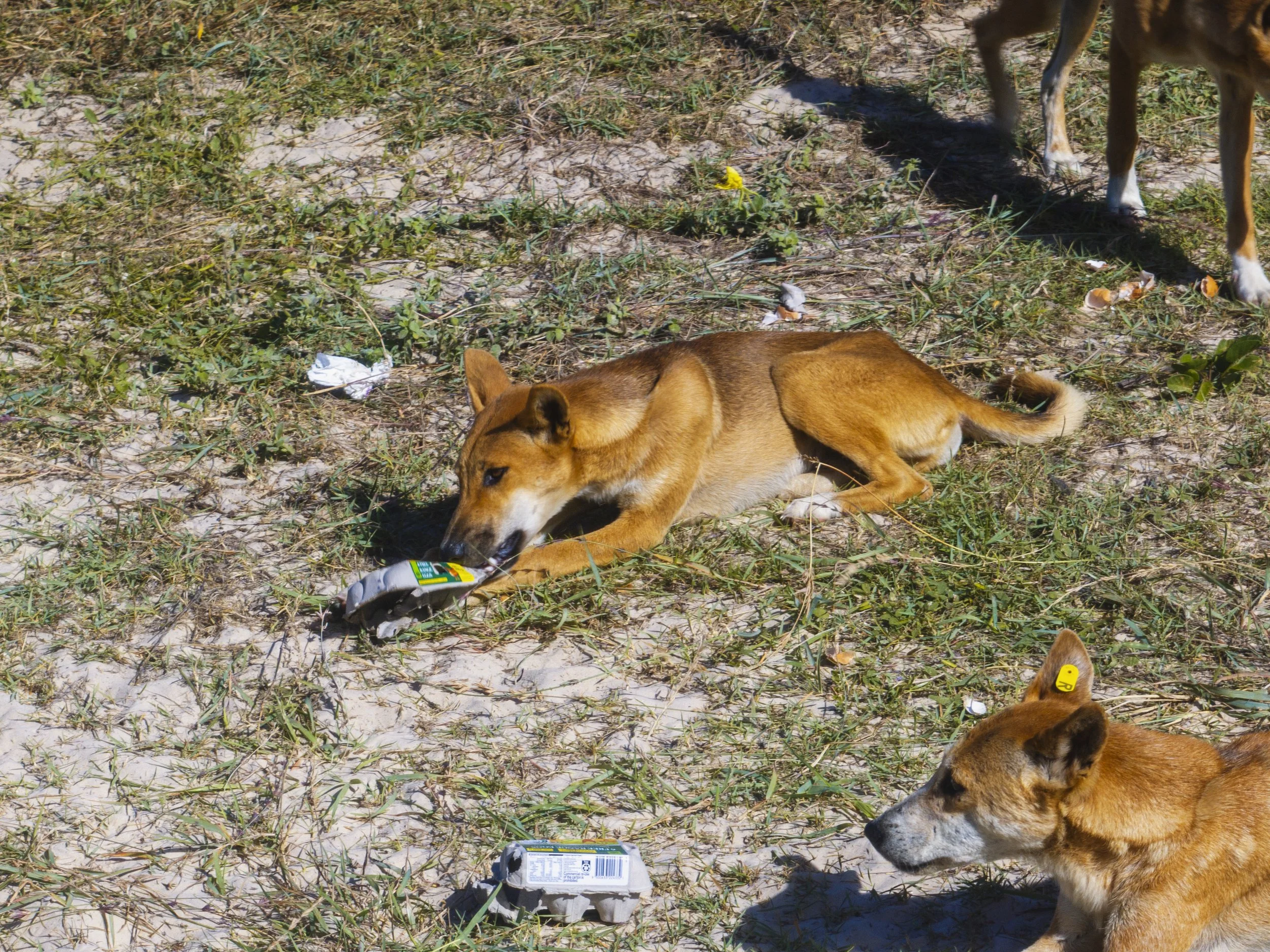
This is how behaviours are passed down. Not through instinct alone, but through observation. The swag was soon torn open completely, and one by one, the dingoes climbed inside to continue foraging. Eventually, a dingo managed to drag the entire bag out, spilling its contents across the sand: blueberries, eggs, bacon, nectarines, bread, biscuits and just about everything you could imagine. The pack took turns eating before calmly moving further south, almost certainly in search of the next unattended campsite.
K’gari Dingoes photographed by Harry Vincent
The Starving Dingo Myth
There’s a persistent belief that dingoes on K’gari are starving, and that incidents like this are driven by desperation. This simply isn’t true.
Food availability on K’gari is abundant. Dingoes feed on fish, birds, possums, insects, reptiles, macropods, vegetation, and anything that washes up along the shoreline. The very next morning after filming this campsite raid, we documented a young dingo pup successfully killing an injured seabird on the beach.
There’s also a common misconception that brumbies were once a primary food source for dingoes on K’gari. Yet in alpine regions where brumbies still exist, dingoes do not hunt them — making it highly unlikely they ever formed a significant part of the island’s dingo diet.
Dingoes are not starving. They are highly intelligent, capable hunters. Like most wildlife, they will always choose the lowest-risk, highest-reward option. Unsecured human food is far easier to access than expending energy to hunt natural prey. This is not a dingo problem — it’s a human one.
K’gari Dingoes photographed by Harry Vincent
Conditioned Behaviour Has Consequences
Incidents like this are often framed as evidence of aggressive or dangerous dingoes. In reality, they are the predictable result of repeated exposure to unsecured food and inappropriate human behaviour.
K’gari is the only place in Australia where dingoes are truly protected — and yet, paradoxically, they are still persecuted. Animals are destroyed not because they are inherently dangerous, but because they’ve been conditioned by people who don’t understand the impact of their actions.
Over the past four years, I’ve spent countless hours observing dingoes in some of the most remote parts of Australia. I’ve never had a single interaction that was aggressive, threatening, or confrontational. When dingoes are not food-conditioned, they are naturally cautious, observant animals that avoid people altogether.
K’gari Dingoes photographed by Harry Vincent
Responsibility Starts With Us
There’s often a reflexive reaction when footage like this is shared and a belief that documenting these incidents somehow creates the problem, or that choosing to film rather than intervene is irresponsible. In reality, the opposite is true.
Filming moments like this isn’t about sensationalism or “airtime.” It’s about transparency. These interactions are already happening, often daily, whether a camera is present or not. Pretending they don’t exist, or trying to quietly manage them out of sight, does nothing to address the underlying cause.
As filmmakers, scientists, rangers, and advocates alike know, meaningful change doesn’t come from looking away — it comes from clearly showing what’s going wrong and why. Footage like this provides crucial context: not just the behaviour of dingoes, but the human actions that precede it. Without that evidence, the narrative almost always defaults to blaming the animal.
The uncomfortable truth is that negative outcomes for dingoes are not driven by documentation; they’re driven by repeated human mistakes. Calling attention to those moments isn’t careless; it’s necessary. Especially when the alternative is silence, denial, or oversimplified blame that ultimately costs dingoes their lives. In situations like this, it’s often those furthest from the field who speak with the greatest certainty. Their armchair conservation knowledge shaped by social media algorithms rather than experience, while the realities on the ground tell a far more complex story.
The rangers on K’gari work incredibly hard and care deeply about both the island and its dingoes. But they can’t be everywhere at once.
Real change happens at an individual level when people secure their food properly, respect guidelines, and understand that their actions directly shape dingo behaviour. When visitors do the right thing, everyone benefits: people stay safe, and dingoes are allowed to live as wild animals, in a place that is meant to be their refuge.
This story shouldn’t have happened — and it doesn’t need to happen again.
The Response
When I shared the footage, the response was immediate and overwhelming. Overnight, the video reached more than a million people, spreading far beyond the audiences that usually engage with nuanced conservation stories. With that reach came a flood of reactions — concern, anger, fear, misinformation, and deeply emotional responses — many of which focused solely on the dingoes, rather than the human behaviours that led to the encounter in the first place. The speed and scale of those reactions were confronting, but it also underscored exactly why this documentation matters. These interactions are not rare, isolated incidents; they are happening in plain sight, yet are widely misunderstood. The virality of the video didn’t create the problem; it revealed it.
In the aftermath of the video’s rapid spread, one journalist from NCA NewsWire reached out to me directly to seek context and comment before publishing an article for news.com.au. That outreach stood in contrast to what had already occurred overnight, with the footage being shared and republished by multiple outlets without any attempt to contact me at all. It followed a familiar pattern — content being lifted, reframed, and circulated without context, while the person who filmed it and understood the circumstances was excluded from the conversation. When stories like this are told without the voices of those who witnessed them firsthand, nuance is lost, and the narrative too often defaults to fear-driven conclusions rather than informed discussion.
That pattern of people helping themselves to my work without permission isn’t limited to media outlets, either. It’s been mirrored by a small but loud corner of the “advocacy” space where criticism comes easily, while original effort does not. Imitation might be the sincerest form of flattery, but at this point, it’s starting to feel more like a content strategy. If documenting reality is such a problem, it’s worth asking why stealing, distributing and profiting off that documentation seems to be just fine as long as they are the ones doing it all in the name of “defending” wildlife.